Simple biology. Solid science.
Learn how evolution works without the jargon.
This site explains evolution in plain language, corrects common myths, and shows why evolution matters in medicine, farming, and everyday life.
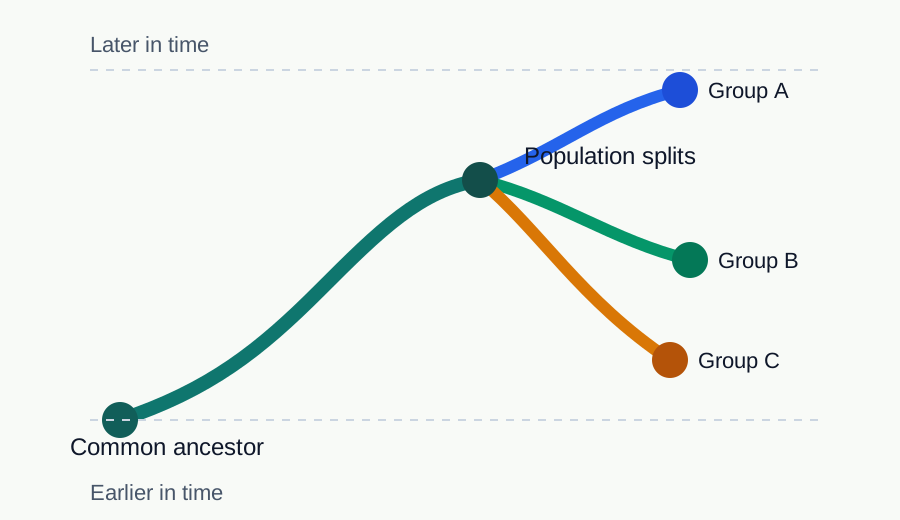
How evolution builds diversity
Small inherited differences appear, environments filter them, and lineages branch over time.
Keep explanations scientifically correct.
Use simple words first and define harder terms when needed.
Show evidence, not just claims.
Start here: a guided path
Eight short reads, in order. Each one builds on the one before it.
- What is evolution? Evolution is change in the inherited traits of a population over generations. Mutation, natural selection, genetic drift, and gene flow drive it, and over deep time it links all living things in one family tree.
- Natural selection Natural selection happens when individuals with certain inherited traits leave more offspring than others in a particular environment. Scientists have measured it in the wild, in mice, moths, and finches.
- Mutation A mutation is a change in DNA. Each person is born with roughly 50 to 70 new ones. Most do nothing, some cause harm, and a few help. They arise at random with respect to need, and they supply the raw variation that evolution works with.
- Genetic drift Genetic drift is evolutionary change caused by random sampling. It can make variants more or less common even when they neither help nor hurt, and its effects are strongest in small populations.
- Speciation Speciation is when one lineage splits into two that no longer share genes freely. It can follow geographic separation, a switch to a new food plant, or a doubling of chromosomes. It can take one generation or millions of years.
- Evidence for evolution Evolution is supported by many lines of evidence, not just one. Fossils, DNA, anatomy, and direct observations point to the same broad picture.
- Common misconceptions Many misunderstandings about evolution come from everyday meanings of words like theory, random, and ancestor. This section slows down those words and explains them correctly.
- Evolution in the real world Evolution is not only about the past. It affects human health, food systems, disease control, and how living things respond to changing environments.
Why evolution matters
Evolution helps explain antibiotic resistance, new virus variants, crop breeding, and why living things share common features.
Antibiotic resistance
Antibiotic resistance evolves when bacteria that survive a drug multiply and pass on their resistance. Bacteria can also share resistance genes directly, which is why the problem spreads so fast.
Virus evolution and vaccines
Viruses evolve while they copy themselves inside us. That is why flu vaccines are rebuilt each year, why COVID variants appeared so quickly, and why the measles vaccine has stayed the same.
Artificial selection
People have been running evolution experiments for thousands of years without calling them that. Artificial selection and natural selection work the same way. Only the filter is different.
Are humans still evolving?
Humans are still evolving. Lactase persistence, high-altitude adaptation in Tibet and the Andes, and sickle-cell trait are all recent, measurable changes in human populations.
Explore the main sections
Clear, accurate, middle-school-friendly explanations of evolution, evidence, and common myths.
Basics
Evolution basics
Start here: the core ideas of evolution in plain language, from variation and natural selection to mutation, drift, and new species.
Misconceptions
Common misconceptions
Clear, evidence-based answers to common myths about evolution, from 'just a theory' to 'humans came from monkeys', in plain language.
Evidence
Evidence for evolution
A guide to fossils, genetics, anatomy, and observed changes that together support evolution.
Real-world evolution
Evolution in the real world
How evolution shapes daily life today: drug-resistant bacteria, new virus variants, crop and dog breeding, pesticide resistance, and human change.
Simulations
Evolution simulations
Simple interactive tools that make natural selection, drift, and deep time easier to picture.
Glossary
Glossary
Plain-language definitions of about 50 evolution terms, A to Z, each with a short example and a link to the article that explains it in full.
Deep dives
Longer articles that follow one question all the way through, with the studies behind each answer.
How did the eye evolve?
Darwin called the eye an apparent difficulty and then answered it. Every stage of eye evolution, from a light-sensitive patch to a focusing lens, exists in a living animal today.
Human evolution timeline
A dated walk through human evolution, from Sahelanthropus about 7 million years ago to Homo sapiens, and why the story is a branching bush rather than a ladder.
How do we know the age of fossils?
How scientists date rocks and fossils, from rock layers and index fossils to radiometric clocks, half-lives, and the cross-checks that make the numbers trustworthy.
Microevolution and macroevolution
Why small changes and large changes in evolution use the same mechanisms, and why the split between them is about scale, not about a barrier in nature.
Convergent evolution and homology
Why a bat wing and a whale flipper share a hidden bone plan, why a shark and a dolphin do not, and how biologists tell inherited similarity from copied solutions.
Vestigial structures and imperfect design
Whale hip bones, the human appendix, goosebumps, and a nerve that takes a detour of metres. What leftover body parts reveal about inherited history.
Darwin and the history of the idea
How the idea of evolution developed, from Lamarck and the Beagle voyage to Wallace's 1858 letter, Origin of Species, Mendel's peas, and the modern synthesis.
Does evolution explain the origin of life?
Evolution explains how life changes once it exists. The origin of life is a separate open question, studied by a separate field. Here is what is known and what is not.
Questions people actually search for
Straight answers to the questions readers type into search engines.
Did humans evolve from monkeys?
Humans did not evolve from the monkeys alive today. Humans and modern monkeys share older common ancestors.
Is evolution just a theory?
In science, a theory is a well-tested explanation supported by evidence. Evolution is called a theory in that strong scientific sense.
Is evolution random?
Some parts of evolution involve chance, such as mutation and genetic drift. But natural selection is not random in the same way.
Are there no transitional fossils?
Transitional fossils exist. They are fossils that show a mix of older and newer traits expected if groups changed over time.