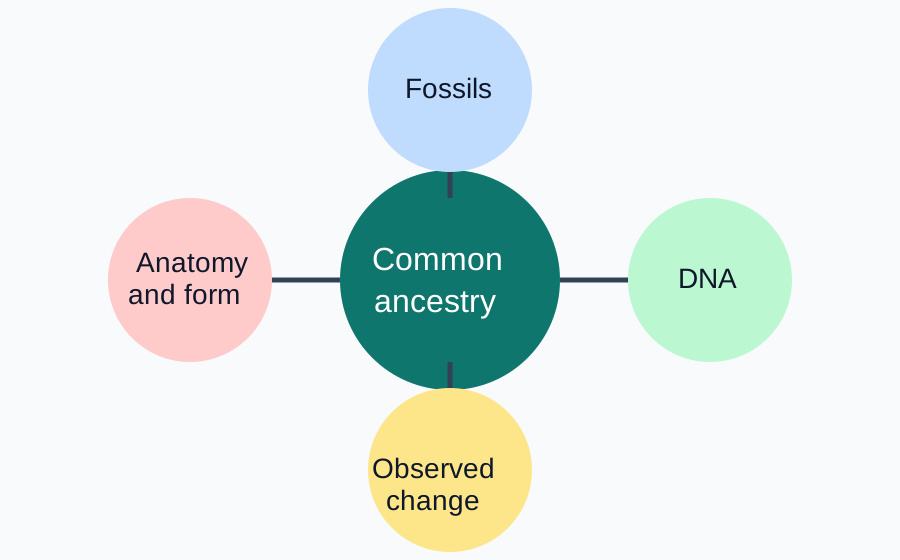
Key idea: Fossils, DNA, body structure, and changes measured in living populations were studied separately, and they all point to the same history of life sharing common ancestors.
Why more than one line of evidence
If only one type of evidence supported evolution, people could reasonably ask whether that evidence had been misunderstood. But that is not the situation. Several independent fields, working with different methods, arrive at compatible conclusions.
That is one reason the case for evolution is so strong. Below, each line of evidence comes with named examples. Each one has a name, a date, or a number attached, so you can check it yourself.
| Line of evidence | What it shows | Example |
|---|---|---|
| Fossils | Life changed in a time order, and in-between forms existed | Tiktaalik, a fish with a neck and wrist bones, found in 375-million-year-old rock |
| Genetics | Related species share DNA, including the same old mistakes | The fused human chromosome 2 and the broken vitamin C gene |
| Anatomy | Related species share body plans and leftover parts | Tiny hip bones in whales; the same bone layout in arms, wings, and flippers |
| Direct observation | Populations change in ways we can measure today | Lenski’s E. coli; Galapagos finch beaks after a drought |
The four main lines of evidence
Fossils
The fossil record shows that life has changed through time. Different groups appear in patterns that match evolutionary history instead of appearing all at once. Fish show up in older rock than the first four-legged animals, and those show up before the first mammals and birds.
One of the clearest examples is Tiktaalik roseae, a fossil fish found in 2004 on Ellesmere Island in the Canadian Arctic. Scientists predicted they would find a fish with early land traits in rock about 375 million years old, and that is exactly where Tiktaalik turned up, complete with a flat head, a neck, sturdy ribs, and wrist bones inside its front fins. The whale fossil series, running from the land-dwelling Pakicetus about 50 million years ago to fully aquatic whales like Basilosaurus and Dorudon about 40 million years ago, tells a similar story in a different lineage. So does Archaeopteryx, about 150 million years old, and the feathered dinosaurs later found in the Liaoning region of China, which together show feathers evolving in stages. For more named in-between forms, see Are there no transitional fossils?.
Ages like “375 million years” are not guesses. Rocks often contain tiny amounts of radioactive elements that break down into other elements at a fixed, known rate. By measuring how much of the original element remains, scientists calculate how long ago the rock formed. This method, called radiometric dating, is what let researchers know which rock layers to search before they ever found Tiktaalik. How do we know the age of fossils? explains it step by step.
Genetics
DNA reveals family relationships. Species that share a more recent ancestor usually have more DNA in common than species whose shared ancestor is much older.
Human chromosome 2 is a clear case. Humans have 23 pairs of chromosomes, while other great apes, including chimpanzees, have 24. Human chromosome 2 carries the leftover, non-working remains of a second centromere and a stretch of telomere sequence buried in its middle instead of at its tip, exactly where two separate ape chromosomes would have joined into one.
Humans also carry a broken, non-working copy of the GULO gene, the gene for making vitamin C. Apes share the same disabling damage in the same places, which is why all of us need vitamin C in our diet. A third example comes from ancient viruses. Some viruses insert copies of themselves into an animal’s DNA, and if that happens in a sperm or egg cell, the inserted virus gets passed down to every later generation. Humans and chimpanzees share thousands of these leftover viral insertions at matching positions in the genome, a pattern that is extremely unlikely to arise twice by chance.
Anatomy and development
Living things often share body plans and developmental patterns that make sense if they inherited them from common ancestors. Some structures make the most sense as leftovers: traits that had a job in an ancestor and no longer do. Scientists call these vestigial structures.
Modern whales still carry tiny pelvic and leg bones, unconnected to any legs, left over from four-legged ancestors. Humans carry muscles that raise goosebumps on skin with far less hair than our ancestors had, and a nerve in the neck called the recurrent laryngeal nerve, which loops down into the chest and back up again on its way to the voice box. In giraffes, that same nerve travels several meters out of its way. The detour only makes sense as a leftover from fish-like ancestors whose relevant nerve and blood vessel sat close together, with no neck in between. Vestigial structures and imperfect design has more examples.
Shared body plans tell a related story. The bones inside a human arm, a bat wing, and a whale flipper follow the same basic layout: one long upper bone, two lower bones, then a wrist and a set of digits, just stretched, shortened, or webbed for different jobs. Structures like these, built on the same underlying plan but used differently, are called homologous structures. The simplest explanation is that all three limbs are modified versions of the same limb, inherited from one shared ancestor.
Direct observation
Scientists can watch populations change in the present. This is especially clear in fast-reproducing organisms such as bacteria and viruses, but it is not limited to them.
In 1988, biologist Richard Lenski started 12 populations of E. coli bacteria growing in flasks, and the experiment has now run for tens of thousands of generations. Around generation 31,500, one population evolved the ability to use a new food source, citrate, a result his team reported in 2008. On Daphne Major in the Galapagos, Peter and Rosemary Grant measured finch beaks growing about 4 to 5 percent deeper within a single generation, after a severe drought in 1977 favored birds that could crack tougher seeds. In industrial Britain, a dark form of the peppered moth went from rare to dominant within about 50 years as soot darkened tree trunks, and modern re-tests have confirmed the result and pinned down the gene responsible.
Change can be even faster. In 1971, biologists moved five pairs of Italian wall lizards to a small island called Pod Mrcaru. About 30 generations later, many of the lizards had a new valve in their gut that helps them digest a plant-heavy diet. Evolution can also happen inside a single human body: HIV, the virus that causes AIDS, can evolve resistance to a drug within weeks, which is why HIV treatment normally uses several drugs together rather than one. Antibiotic resistance is the same process at work in bacteria, and it is one of the most medically important examples of evolution happening today.
Open questions are normal
Supporting evolution does not mean scientists know every detail of every lineage. Science often knows the big picture very well while still refining details. That is normal. We can be confident about common ancestry and evolutionary change even while some branches of the tree are studied in more detail than others.
Why the match is convincing
Look at what these examples have in common. Tiktaalik’s age was predicted before it was ever found. The chromosome 2 fusion left two separate physical markers exactly where a fusion should leave them. Vestigial structures turn up in the same lineages the fossil record already says descended from four-legged or fish-like ancestors. Lenski’s bacteria and the Grants’ finches show the same kind of process, favoring one trait over another, that fossils and DNA say has been running for hundreds of millions of years.
None of these lines of evidence needs any of the others to be true. A skeptic could, in principle, question any one of them on its own. But all four keep landing on the same answer, using completely different methods, in completely different fields, discovered decades apart by different scientists. That kind of agreement is very hard to produce by coincidence.
Think about what it would take to fake that agreement. A paleontologist digging in the Arctic would need to place a fossil in exactly the right rock layer. A geneticist sequencing chromosomes, with no knowledge of that dig, would need to independently find a fusion scar in the right place. A field biologist counting finch beaks on a tiny Pacific island would need to see the same kind of change, on a much shorter timescale, for a completely different reason. None of these scientists set out to confirm each other’s work. They were answering separate questions with separate tools, and the answers matched anyway.
The next time someone says there is no real evidence for evolution, these four examples are a good place to start: a fish with a wrist found exactly where predicted, a chromosome that still carries the scar of its own fusion, a nerve that takes a pointless detour inherited from fish ancestors, and bacteria that scientists watched evolve a new ability, one counted generation after another.
Where to go next
Each line of evidence has its own page. Read fossil evidence for Tiktaalik and the whale series in more detail, genetic evidence for chromosome 2, the broken vitamin C gene, and ancient viruses in our DNA, and observed evolution for more cases measured in living populations.