Lenguaje claro, ciencia sólida
Aprende cómo funciona la evolución sin jerga difícil.
Este sitio explica la evolución con palabras sencillas, corrige mitos comunes y muestra por qué importa en la medicina, los virus y la agricultura.
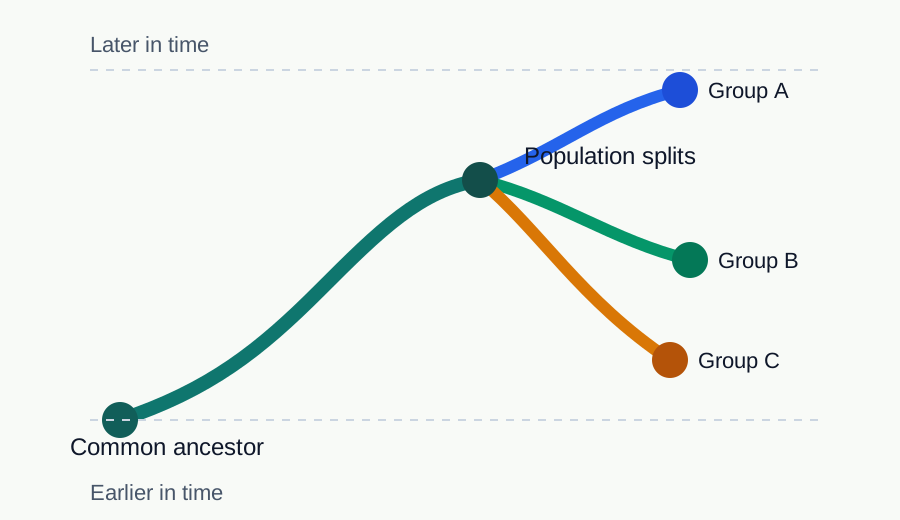
Cómo la evolución crea diversidad
Aparecen pequeñas diferencias heredadas, el ambiente las filtra y las líneas se ramifican con el tiempo.
Mantener la información científicamente correcta.
Explicar términos difíciles con palabras simples.
Mostrar evidencia, no solo afirmaciones.
Empieza aquí: un recorrido guiado
Ocho lecturas breves, en orden. Cada una se apoya en la anterior.
- ¿Qué es la evolución? La evolución es el cambio de rasgos heredados en una población a lo largo de generaciones.
- Natural selection Natural selection happens when individuals with certain inherited traits leave more offspring than others in a particular environment. Scientists have measured it in the wild, in mice, moths, and finches.
- Mutation A mutation is a change in DNA. Each person is born with roughly 50 to 70 new ones. Most do nothing, some cause harm, and a few help. They arise at random with respect to need, and they supply the raw variation that evolution works with.
- Genetic drift Genetic drift is evolutionary change caused by random sampling. It can make variants more or less common even when they neither help nor hurt, and its effects are strongest in small populations.
- Speciation Speciation is when one lineage splits into two that no longer share genes freely. It can follow geographic separation, a switch to a new food plant, or a doubling of chromosomes. It can take one generation or millions of years.
- Evidencia de la evolución La evolución no se apoya en una sola prueba. Varias líneas de evidencia coinciden.
- Mitos comunes Muchos malentendidos aparecen porque palabras como teoría o azar tienen un sentido distinto en ciencia.
- Evolución en la vida real La evolución no es solo una historia del pasado. También afecta problemas actuales.
Por qué importa la evolución
La evolución ayuda a explicar la resistencia a antibióticos, las nuevas variantes de virus, la cría de cultivos y las similitudes entre los seres vivos.
¿Qué es la evolución?
La evolución es el cambio de rasgos heredados en una población a lo largo de generaciones.
Natural selection
Natural selection happens when individuals with certain inherited traits leave more offspring than others in a particular environment. Scientists have measured it in the wild, in mice, moths, and finches.
Is evolution just a theory?
In science, a theory is a well-tested explanation supported by evidence. Evolution is called a theory in that strong scientific sense.
Antibiotic resistance
Antibiotic resistance evolves when bacteria that survive a drug multiply and pass on their resistance. Bacteria can also share resistance genes directly, which is why the problem spreads so fast.
Explora las secciones principales
Un sitio educativo para explicar la evolución con lenguaje simple y ciencia correcta.
Conceptos básicos
Conceptos básicos de la evolución
Una guía simple para entender las ideas principales detrás de la evolución.
Mitos comunes
Mitos comunes
Respuestas claras a ideas equivocadas muy frecuentes sobre la evolución.
Evidencia
Evidencia de la evolución
Fósiles, genética y cambios observados que apoyan la evolución.
Evolución en la vida real
Evolución en la vida real
Ejemplos de evolución en medicina, virus, agricultura y salud pública.
Simulaciones
Simulaciones
Herramientas interactivas simples para visualizar procesos evolutivos.
Glosario
Glosario
Definiciones breves y claras de términos importantes sobre evolución.
Preguntas que la gente realmente busca
Respuestas directas a las preguntas que los lectores escriben en los buscadores.
Did humans evolve from monkeys?
Humans did not evolve from the monkeys alive today. Humans and modern monkeys share older common ancestors.
Is evolution just a theory?
In science, a theory is a well-tested explanation supported by evidence. Evolution is called a theory in that strong scientific sense.
Is evolution random?
Some parts of evolution involve chance, such as mutation and genetic drift. But natural selection is not random in the same way.
Are there no transitional fossils?
Transitional fossils exist. They are fossils that show a mix of older and newer traits expected if groups changed over time.